What makes a precision platformer fair? Three tiny timers
2026-11-27 • Abdul Manan
A precision platformer is a game where the jumps are tight and a small mistake kills you. What makes one feel fair is not how hard it is. It is whether every death feels like your mistake. A lot of that comes down to a few timers the player never sees.
I make Deadweight, a mountain climbing game for iPhone and iPad. You get a left button, a right button and a jump button, and every fall is a death. So the jump has to behave the same way every time. Here is how mine works, with the real numbers from the code.
Timer one: the edge forgives you
Walk off a ledge and you can still jump for 120 milliseconds. Your feet are over air, but the game still counts you as standing.
Without this, you press jump at the edge, the climber is a few pixels past it, and nothing happens. You fall. On a phone, with a thumb on glass, that happens a lot, and it never feels like your fault.
There is a second part to it. In those 120 milliseconds you have already started to drop. If the jump just added its push on top of that, you would get a weak little hop. So the jump wipes out the falling speed first, and a late jump off the edge rises just as far as an early one.
Timer two: a landing takes a beat
When you land, there is a 120 millisecond beat before you can jump again.
It keeps the rhythm of a climb even. Land, beat, jump. You learn it without knowing it is there.
Timer three: a tap in that beat is kept
That beat caused a real problem in testing. A tap that came right as you landed did nothing, because it fell inside the beat and the game threw it away.
So now a tap during the beat is not thrown away. The game keeps it for 150 milliseconds and fires the jump on its own the moment the beat ends.
The two numbers are picked against each other. The beat is 120 milliseconds and the game keeps a tap for 150, so a tap at any point during the beat still turns into a jump.
Let go early, jump lower
Hold jump and you get the full height. Let go while you are still going up and the climber stops rising sooner. A quick tap goes about 80% as high as a full hold.
There is one exception, and it is on purpose. A tap kept from the landing beat fires after your thumb is already off the glass, so the game cannot know how long you meant to hold. It gives you the full jump.
Why I bother
None of this shows up in a screenshot. Nobody looks at a precision platformer and admires the landing beat. But they feel it when the timing is off, and they put the phone down.
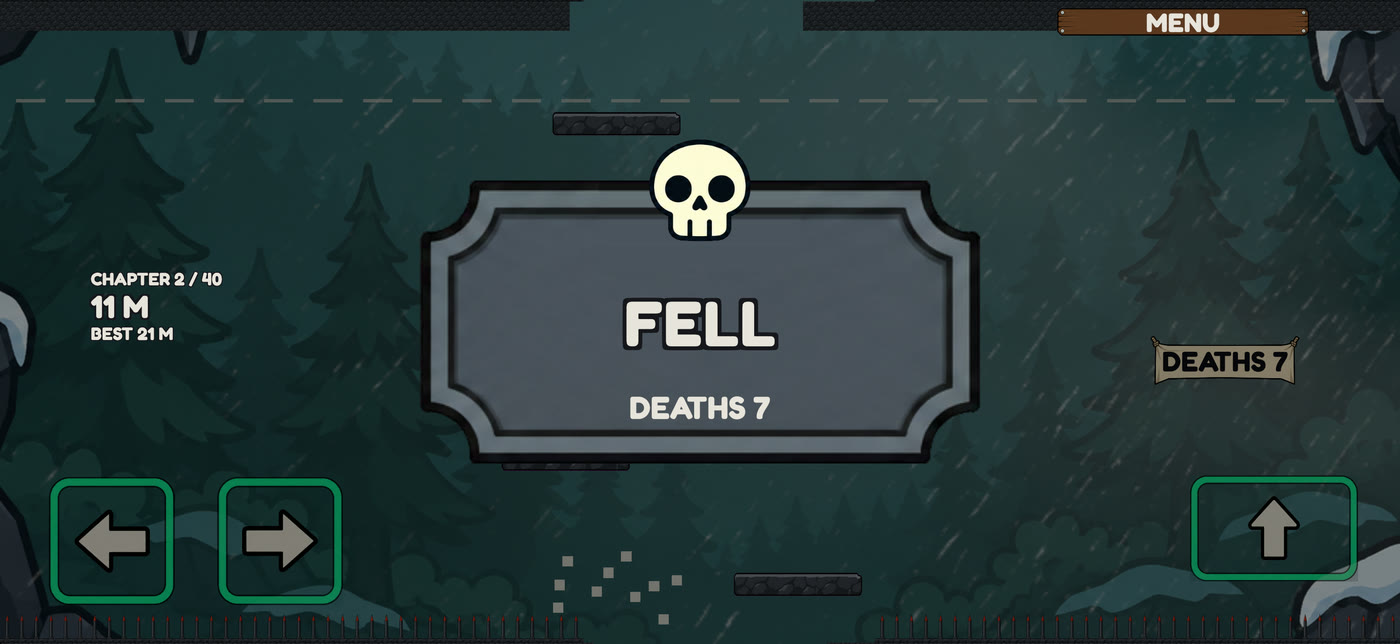
What I want is simple. When you die in Deadweight, the reason should be the jump you made: too early, too late, or too far.
Try the jump
The first chapter, The Foothold, runs right here in your browser with the same timers and the same numbers as the game. The full game has 200 levels, and the first 10 are free.